As featured in



-
£240,000
Biggest grant won using Raiser so far
-
£0
What it costs your charity. Now and always.
-
Raiser
Built by fundraisers, for fundraisers
The sector has been trying to fix this for twenty years. In rooms you weren’t invited to.
For as long as small charities have been applying for grants, funders and sector bodies have been sitting around tables — conferences, roundtables, working groups — asking each other: wouldn’t it be nice if there were one place where charities could describe their impact in a common language? Wouldn’t it be nice if funders could find organisations based on what they actually do and prove, rather than how well they write a 500-word application?
The conversations happen. Sometimes they produce frameworks. Sometimes they produce reports. Occasionally they produce a shared portal that three funders use for a year before the funding runs out and the whole thing quietly closes.
What they rarely produce is something that actually solves the problem.
And there’s a reason for that: the people in those rooms are mostly funders. The charities might get consulted. The beneficiaries almost never do. The result is systems designed around funder accountability requirements, not around how a charity actually records and understands its own work. They reduce friction for funders while adding more for charities. They’re optimisation — not transformation.
The real problem has never been a missing form template. It’s this: charities are brilliant at making an impact, and funders have significant sums of money to direct toward social change. The transaction at the centre of all of this is actually simple. The machinery that’s built up around it — the application forms, the monitoring reports, the quarterly case studies — has made it needlessly expensive, slow, and exhausting for the people doing the best work.
We’re not tweaking the machinery. We’re replacing what it was supposed to do.
What impact reporting is actually costing you.
The average small charity spends 38% of its grant income just on applying for and reporting against grants. Not delivering services. Not changing lives. Filling in forms and writing case studies that will sit in a funder’s inbox, unread, until the next reporting cycle comes around.
The reporting burden is staggeringly disproportionate. A £15,000 grant can require monthly case studies, quarterly data returns, and a final report that takes as long to write as the original application. Meanwhile, larger institutional funders often require less frequent reporting for ten times as much income.
What makes it worse: most charities don’t believe anyone reads it. The data goes in. The silence comes back. There’s no feedback loop, no indication that it shaped anything, no sense that the evidence you’ve carefully gathered is informing how the funder operates. It’s accountability theatre — and everyone involved knows it.
“It can feel, sometimes, as though you’re sending these crafted reports back to the aether to be read by one grant manager and then archived forever.”
The result is a sector spending enormous energy performing impact rather than understanding and communicating it honestly. The charities that win funding aren’t always the ones doing the most effective work. They’re often the ones who’ve learned to write best for whoever’s reading.
That’s not a funding system. That’s a lottery with extra paperwork.
A living record of your work. Built by you, owned by you.
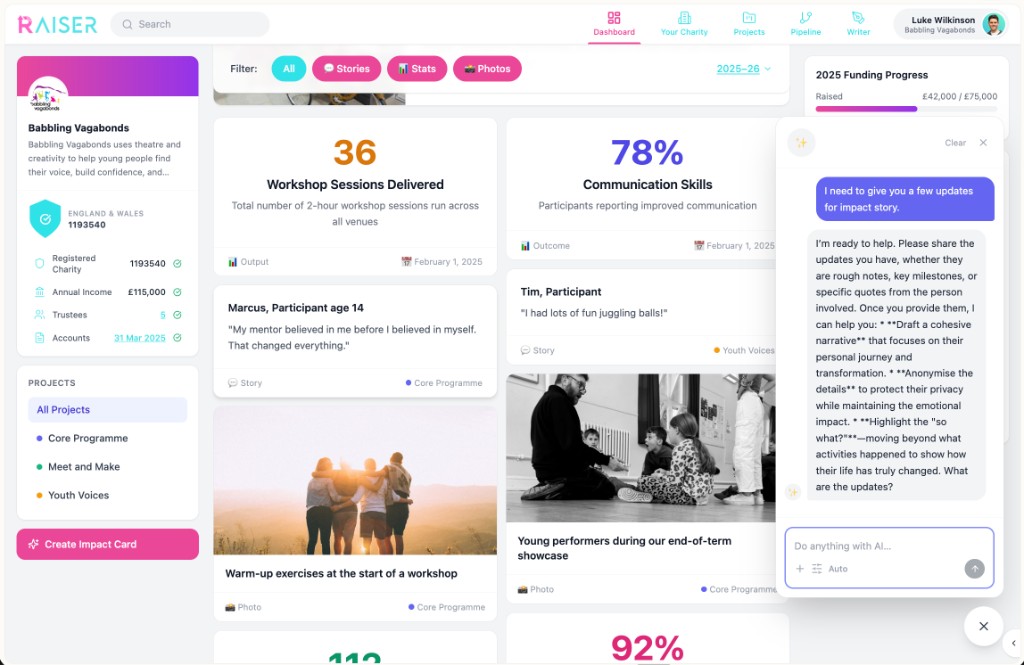
The Impact Story™ is the beating heart of Raiser. It’s where everything you do — every session you run, every beneficiary you support, every outcome you track, every quote that captures what your work means — lives in one place.
Not a report. Not a framework someone else designed. Not a form to fill in at the end of a grant period. A living record, built continuously as your work happens, that reflects the actual reality of your charity’s impact.
It’s made up of impact cards — individual pieces of evidence that you add as you go. Each card captures something real: a number, a quote, an outcome, a moment. Over time, the cards build into the story of your charity’s work — one that’s specific to you, grounded in your evidence, and ready to use whenever someone asks you to prove what you do.
Three types of evidence. Infinite ways to use them.
-
Quotes and testimony
The words of the people your work reaches. “You gave me somewhere to belong.” “This programme kept me going through the worst year of my life.” These are the moments that matter — and they’re the moments that get lost in spreadsheets and annual reports. An impact card preserves them, attributes them (with permission, anonymously if needed), and makes them retrievable the moment a funder asks for beneficiary voice.
-
Activity and output data
Numbers that tell the story of your reach. How many people attended your drop-in this month. How many hours of one-to-one support you delivered this year. How many meals served, sessions run, referrals made. The things funders always want, recorded in a way that doesn’t require you to remember where you filed last quarter’s spreadsheet.
-
Outcomes and evidence
The change your work makes. “83% of participants reported improved confidence after six sessions.” “Of 24 people supported into employment this year, 19 were still in work after six months.” Measured, structured, attributed to a specific project and timeframe — and available to draw on in every future funding conversation.
The more you build your Impact Story™, the better everything else gets.
This is what makes Raiser different from every other impact measurement tool in the sector.
Your Impact Story™ doesn’t sit in a drawer until someone asks for it. It actively powers the rest of the platform — and gets more useful the richer it becomes.
-
It makes your bid writing better.
Every grant application you write using Raiser draws on your Impact Story™. The bid writer doesn’t draft from a blank page — it draws on your specific evidence, your language, your outcomes. A beneficiary quote logged this week. An attendance figure from last month. An outcome tracked this morning. The more your Impact Story™ reflects the reality of your work, the more accurately and compellingly your applications can speak to what a funder is asking.
-
It makes your reporting easier.
When funders ask for an end-of-grant report, you’re not starting from scratch. Your Impact Story™ has been building throughout the grant period. The data is there. The quotes are there. The outcomes are tracked. Reporting becomes a matter of surfacing what you’ve already recorded — not performing a reconstruction of a year’s work in a stressful final week.
-
It becomes the foundation of something bigger.
We’re building toward a world where funders come to your Impact Story™ directly — where your evidence is accessible, verifiable, and discoverable, rather than buried in an application form or a PDF that no one opens. Your Impact Story™ is the proof of what you do. The more it reflects reality, the closer we get to a system where it can speak for itself.
There’s a name for what we’re building. And a research paper to back it up.
The model Raiser is built on has a formal name: Charity-Centred Reporting (CCR). The idea is straightforward: reporting should be designed to add value to the charity’s own operations first. Funders benefit as a consequence — not at the charity’s expense.
Instead of bespoke reports written from scratch to satisfy each individual funder’s template, CCR proposes that charities maintain a live impact record that funders can access on agreed terms. The charity records what it needs to record for its own learning. The funder gets real-time, authentic evidence — not a sanitised performance.
This isn’t a vague aspiration. Raiser’s Impact Story™ is built specifically to make CCR practical for small charities from day one. And Beckie Denny — Raiser’s Co-CEO and the sector’s leading voice on impact measurement — has written the research case for why this is the direction the whole sector needs to move.
Read the research: Restoring the Balance — The Case for Charity-Centred Reporting (publishing soon at /resources/charity-centred-reporting)
Charities already building their story on Raiser
£5,000
Raised from a local funder
“I didn't think I could get a bid in on time, but Raiser made it possible. Having all of our previous material in one place, plus the fundraising expertise baked in, meant we could quickly and simply put our request to the funder — and it worked!”
Mark Hornsey, Co-Artistic Director, Babbling Vagabonds
£240,000
Core grant over two years
“We're now seeing a massive increase in our capacity to win funding. We're celebrating a big win recently — a £240,000 core grant award over 2 years, written using the Raiser approach.”
Simon Wallwork, CEO, Buxton Crescent Heritage Trust
£10,000
National Lottery Heritage Fund
“We used Raiser to help bring together the school, the church, and the PTA for a project marking the school's 150th anniversary. We ended up securing £10,000 from the National Lottery Heritage Fund.”
PTA Member (name changed for privacy), Primary School PTA
Even the funders think the old way is broken.
“As a trust-based funder and champion of grassroots and small charities, I feel frustrated by the funder-fuelled norms of application processes and impact reporting. Raiser is a much needed leveller and has the potential to reform an inequitable system that gets in the way of facilitating brilliant, impactful work.”
Kate Symondson
The Symondson Foundation
The sector’s best free impact measurement tool. Actually free.
Building and maintaining a rich impact record shouldn’t be another thing your charity has to pay for. Raiser’s Impact Story™ is completely free — for every charity, forever.
We can do this because funders pay for the platform, not charities. Our business model means our incentives are aligned with yours: we do well when charities raise more money and prove more impact. Charging you for impact measurement would be exactly the wrong thing.
Raiser is completely free for charities. No trial. No card. No small print.
Here’s what you get, free, from day one:
- Your full Impact Story™ — unlimited impact cards, projects, outcomes, quotes
- Three card types: testimony, activity/output, outcomes and evidence
- Cards tagged to projects and timeframes
- Impact Story™ powers your Raiser bid writer
- Impact Story™ shared with funders browsing Raiser (when you're ready)
- Grant pipeline and deadline tracking
- Access to the community funder database
- Updates and new features as we build them
Questions we get a lot
How much time does it take to build an Impact Story™?
The most useful answer: less time than your current reporting, once it's running. The initial setup — adding your projects, your key outcomes, your first impact cards — takes a few hours. After that, it's a habit rather than a task: add a quote when you have one, log your monthly numbers when you record them anyway, update outcomes when you review them. The Impact Story™ grows with your work, not at the end of a grant period.
Do I need to have an existing impact framework to use this?
No. If you have one, great — Raiser can reflect it. If you don't, the Impact Story™ structure (activities, outputs, outcomes) gives you a working framework without needing to commission one. You can refine it as you go.
What if our impact is hard to measure?
That's exactly who this is for. Much of the best charity work doesn't fit neatly into a spreadsheet — the human moments, the incremental changes, the things that matter most to the people experiencing them. Raiser's testimony cards are specifically designed to capture qualitative evidence alongside quantitative data. A quote is evidence. A lived experience is evidence. The Impact Story™ is built to hold both.
Will funders actually be able to see this?
You control what's shared. Your Impact Story™ is your data — you decide when and whether it's visible to funders browsing Raiser. As more funders join the platform, your Impact Story™ becomes increasingly discoverable. But nothing is shared without your knowledge and consent.
How is this different from what we already do?
Most charities' evidence lives in a mix of spreadsheets, email threads, Word documents, and people's heads. The Impact Story™ doesn't ask you to do something different — it asks you to do what you already do, in one place, in a format that's immediately useful for funding conversations. The difference is that it accumulates. A year from now, you'll have a body of evidence you can draw on, rather than starting from scratch each time.
Is this actually free? What's the catch?
No catch. Raiser is free for charities because we believe the burden of fundraising admin should shift off your shoulders. We're paid by the funders using our platform to find and fund high impact causes like yours!
Still have questions? Email us at hello@raiser.uk — we actually reply.
Start building the record your charity deserves.
Every piece of work you do is evidence of something real. Every beneficiary supported. Every session delivered. Every outcome measured. Right now, most of that evidence disappears — into a folder, a report, a grant manager’s inbox that nobody checks. The Impact Story™ gives it somewhere to live — and something to do.