The funding system has a visibility problem.
The organisations that win grants most consistently aren’t necessarily doing the most effective work — they’re often the ones with the greatest capacity to navigate the application process. The staff time to write compellingly. The fundraising experience to speak in funder language. The bandwidth to meet every deadline and submit every report on time. That’s not a criticism of them. It’s an observation about what the system selects for.
The small, community-rooted organisations working most closely with the people who need the most support often have none of that. They’re run by one or two people. Their website is three pages updated in 2019. They’ve never heard of a theory of change. But their beneficiaries would queue around the block for them, and their outcomes — if anyone helped them record and articulate them — would stack up against anything a larger organisation can show.
The current system doesn’t find these charities. It filters them out.
Raiser is built to find them — and to give them the tools to describe their work in terms that make funding decisions possible. Not by teaching them to sound like bid writers. By helping them record and communicate what they actually do.
What a charity’s profile on Raiser actually looks like.
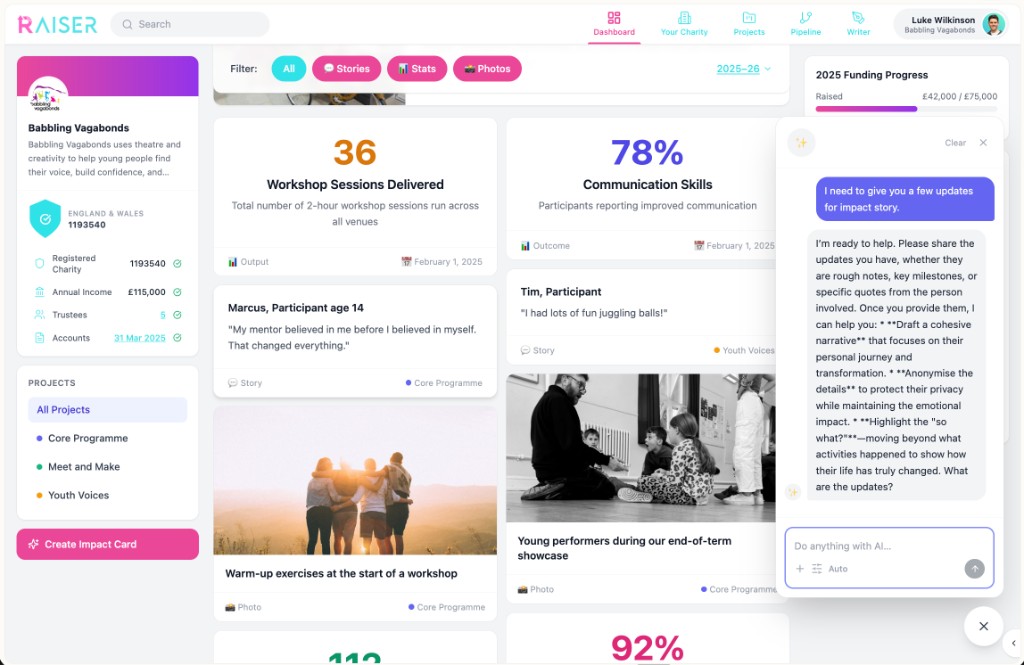
Every charity on Raiser has an Impact Story™ — a structured, living record of their work. Not a static “about us” page. Not a list of previous funders. A dynamic evidence base, built by the charity as their work happens, that gives you a real picture of what they do, who they work with, and what changes as a result.
A charity’s profile shows you:
-
What they do — in a common language.
Their activities are described using the Open Impact Standard — a shared taxonomy built by the sector, for the sector. Youth mentoring is youth mentoring. Food distribution is food distribution. You can search and filter across all charities on the platform by activity type, geography, or outcome area without needing every organisation to have answered your specific questions.
-
Who they work with.
Beneficiary groups, demographic reach, geographic coverage. Defined consistently across all charities on the platform — so you’re comparing like with like, not trying to decode twelve different ways of saying “vulnerable young people in urban areas.”
-
What changes.
Tracked outcomes, with evidence. Not “we help young people achieve their potential” — the kind of outcome statement that’s been written ten thousand times and means nothing. Specific, measured, attributed to real projects: confidence scores, employment rates, health outcomes, community connections. The things that actually happened, recorded by the people who made them happen.
-
The human evidence.
Beneficiary quotes, logged with permission. The moments that don’t fit into a spreadsheet but speak directly to the question every funder is really asking: does this actually matter to the people you serve?
-
The organisation behind the work.
Governance, finances, leadership — the due diligence information you’d look for in any funding conversation. Structured, up to date, and sitting alongside the impact evidence rather than buried in a separate application pack.
We think we’ve thought of everything you’d want to know. We challenge you to find something we haven’t.
This is a fairly bold claim. It’s intentional.
When we built the Impact Story™ structure and the information a charity’s Raiser profile captures, we started from a simple question: what does a funder actually need to know to make a confident funding decision? Not the questions that appear on grant application forms because they’ve always appeared on grant application forms. The information that genuinely informs whether an organisation is effective, well-governed, and worth backing.
We mapped it. We stress-tested it. We asked funders, trustees, programme officers, and independent evaluators to try to break it. The due diligence tab on every charity profile is the result.
It covers:
- Organisational structure and governance
- Financial health and reserves
- Leadership and safeguarding
- Previous funding history
- Activity evidence
- Output data
- Tracked outcomes
- Beneficiary voice
- Independent verification where available
If you can think of something you’d want to know that isn’t there, tell us. We mean that. The Open Impact Standard is a living framework — built with the sector, not imposed on it — and funder input is part of how it improves.
But we think you’ll struggle.
For the first time, you can look across the whole sector and compare like with like.
One of the most persistent frustrations in grant-making is that impact data is locked in incompatible formats. Every charity describes their work differently. Every funder asks about it differently. The result is a sector that can’t learn from itself — where the same programme is reinvented by fifty organisations in fifty postcodes because there’s no shared way to see what already exists and what already works.
The Open Impact Standard is Raiser’s attempt to fix this at the infrastructure level. When a charity on Raiser describes their activity, they’re not just telling their own story — they’re contributing to a shared taxonomy that maps what the whole sector does.
For funders, this means you can do something that’s never really been possible before: search across the platform by what organisations actually do, not by what they’ve said about themselves in a form. Find every organisation running one-to-one mentoring programmes in Greater Manchester. See all the charities working on early intervention for young people’s mental health in the South West. Identify gaps — areas of genuine need where no adequately funded provision currently exists.
The common language isn’t there to make charities sound the same. It’s there so that what makes each one different is actually visible — rather than buried under individual word choices and application form conventions.
The framework is yours to shape too.
The Open Impact Standard is community-built. Charities are already leading the way — every charity that sets up a project on Raiser contributes to the taxonomy, and the framework gets richer and more accurate the more organisations use it.
But funders are part of that community. If there are activity types that aren’t captured, outcome categories that are missing, or evidence standards that need to be higher for the funding decisions you’re making — we want to know.
We’re already in discussion with several sector partners about formal interoperability. The Open Impact Standard is designed to be something any tool can implement, not a proprietary database locked inside Raiser. If you’re building towards better data in your own grant-making, we’d like to talk.
If the information is already there, you don’t need the form.
This is where it leads.
If a charity’s profile on Raiser already contains the due diligence information you need, the impact evidence you’d ask for, and the outcome data you’d want to see — the grant application form is redundant. You already know what you need to know. You can approach them directly.
That’s the future we’re building toward: a funding model where you come to the charity’s Impact Story™, rather than the charity coming to your application portal. Where you can identify the organisations most closely aligned with your priorities, reach out to them, and have a funding conversation grounded in evidence you’ve already reviewed — without asking them to write the same information out for the fifteenth time.
Some funders are already operating this way. The move toward trust-based philanthropy, proactive grant-making, and reduced reporting requirements is real and growing. Raiser is the infrastructure that makes it systematic — not dependent on individual funder goodwill, but built into how the sector connects.
The application form isn’t going away overnight. But every charity that builds a rich Impact Story™ on Raiser is making it less necessary. And every funder who uses the platform is helping to prove that a better model works.
“As a trust-based funder and champion of grassroots and small charities, I feel frustrated by the funder-fuelled norms of application processes and impact reporting. Raiser is a much needed leveller and has the potential to reform an inequitable system that gets in the way of facilitating brilliant, impactful work.”
Kate Symondson
The Symondson Foundation
Ready to meet the charities you’ve been missing?
Book a call with the Raiser team. We’ll show you what’s on the platform, walk you through how the due diligence information works, and talk about how Raiser fits with how you make funding decisions.